
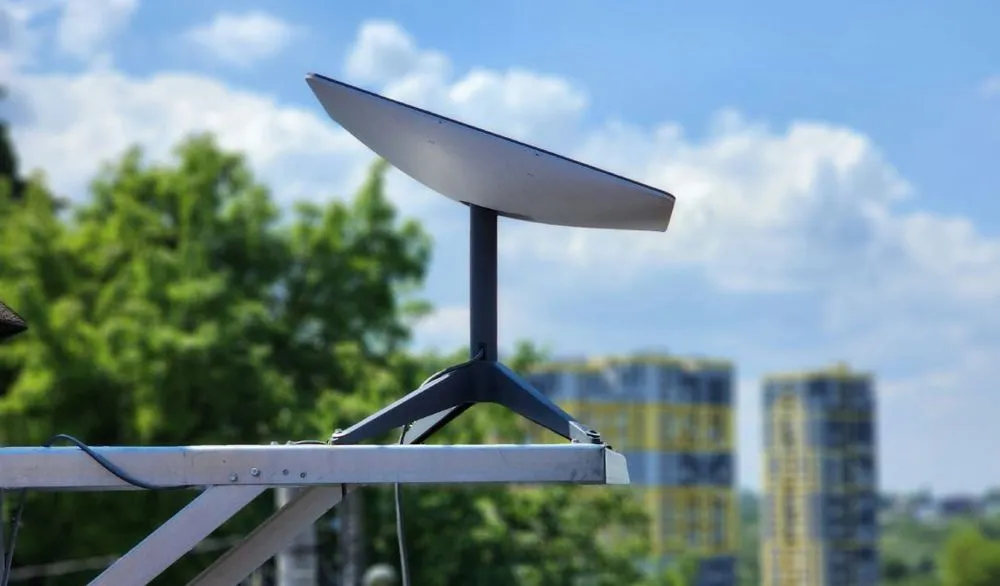
Starlink restrictions hit Russian forces as Moscow seeks workarounds
Ukrainian citizens began receiving unexpected text messages this month from the country’s security service, warning that Russia was trying to recruit locals to help restore access to blocked Starlink satellite internet terminals.
“Such assistance is a criminal offense!” the Security Service of Ukraine (SBU) said in the messages, urging people to report any attempts by Russian operatives to persuade them to register terminals on Moscow’s behalf.
The warning follows Ukraine’s rollout of a new national verification system for Starlink terminals earlier this month. Under the new rules, only registered and verified devices can operate in Ukrainian-controlled territory, with all others automatically disconnected.
Kyiv says the move was necessary after confirming that Russian forces had begun installing Starlink technology on attack drones, allowing them to operate in real time via satellite connections — making the unmanned aerial vehicles harder to jam, track or shoot down.
Disruptions on the frontline
Ukrainian officials claim the crackdown is already affecting Russian operations. Vladyslav Voloshyn, spokesperson for Ukraine’s Southern Defense Forces, said Russian troops had reduced the number of kamikaze drone attacks in the southeastern Zaporizhzhia region after the shutdown.
“There have been fewer kamikaze drone strikes,” he said. “After the disconnection, the enemy experienced certain problems with communication and coordinating infantry assaults.”
Russian military bloggers also reported losing access to Starlink connections, warning that the outages could weaken Moscow’s drone warfare capabilities and hinder coordination between units.
Elon Musk, founder of SpaceX — the company that operates Starlink — appeared to confirm that the action had some effect. “Looks like the steps we took to stop the unauthorized use of Starlink by Russia have worked,” Musk wrote on X, without providing further details.
Moscow has not publicly acknowledged any operational disruptions. However, according to Bloomberg, Russian diplomats recently argued at a United Nations meeting that SpaceX may be violating international space law by failing to account for the interests of other space actors.
Moscow has also called for international negotiations to limit the number of new satellites and clarify the military use of satellite frequencies registered for commercial purposes.
Seeking workarounds
With no domestic satellite internet alternative comparable in speed and portability to Starlink, Russian forces appear to be seeking illicit ways to regain access, Ukrainian officials say.
Serhiy Beskrestnov, an adviser to Ukraine’s defense minister, said Russian operatives are offering cash to civilians in Ukrainian-controlled territory in exchange for registering Starlink terminals in their names.
According to Beskrestnov, the schemes include registering devices at government service centers, using shell companies or attempting to reconnect terminals removed from drones.
“My advice to traitors: don’t even try,” he said, adding that authorities anticipated such tactics and would block any newly activated terminals linked to Russian use.
Ukraine’s state agency responsible for prisoners of war said Russian operatives have also pressured the families of captured Ukrainian soldiers to register terminals on Russia’s behalf — a claim that could not be independently verified.
“Cooperating with the enemy is extremely dangerous,” the agency said, noting that official registration requires identity verification, making participants easily identifiable.
Cyber countermeasures
Ukrainian hackers said they have turned Russia’s dependence on Starlink into an intelligence opportunity.
Last week, a group calling itself the 256th Cyber Assault Division said it had tricked Russian soldiers into revealing their positions and sending money by posing as a service that could restore disconnected terminals.
The group said it instructed Russian servicemen to submit identifying information and the coordinates of their devices under the pretense that the terminals would be reactivated through Ukrainian administrative service centers.
It said it collected 2,420 data packets related to Russian-used terminals and passed them to Ukrainian law enforcement and defense agencies. The group also said it received $5,870 from Russian soldiers seeking to restore connectivity, which it plans to donate to fundraising efforts for Ukrainian drones.
The hackers’ claims could not be independently verified.



Daryna Antoniuk
is a reporter for Recorded Future News based in Ukraine. She writes about cybersecurity startups, cyberattacks in Eastern Europe and the state of the cyberwar between Ukraine and Russia. She previously was a tech reporter for Forbes Ukraine. Her work has also been published at Sifted, The Kyiv Independent and The Kyiv Post.